Switch-capacitor circuits take advantage of the fact that the circuit characteristic only depends on capacitance ratios which turn out to be very accurate tanks to the excellent matching of capacitors. They are increasingly used in many more applications like radio frequency (RF) circuits or sensor front-end circuits to perform various analog signal processing operations such as sampling, amplification or filtering.
The performance of SC circuits is ultimately limited by the thermal and flicker noise (or 1/f noise) generated by the amplifiers and by the thermal noise coming from the switches. Since SC circuits are sampled-date systems, the broadband thermal noise is aliased into the Nyquist band, resulting in an increase of the noise power spectral density (PSD) by a factor equal to the ratio of the equivalent noise bandwidth to the Nyquist frequency which is usually much larger than one. The 1/f noise contribution can therefore usually be neglected and if it still remains important, the amplifier 1/f noise and offset can be reduced by increasing the transistor gate areas or eventually eliminated thanks to circuit techniques like auto-zeroing or chopper stabilization. Under such conditions, the sampled thermal noise remains the dominant noise source particularly when minimal capacitance values are used, since the sampled noise voltage variance is inversely proportional to the capacitance.
Since the power consumption and silicon area are proportional to the capacitance, whereas the noise voltage variance is inversely proportional to the capacitance, it is crucial to identify which capacitances are setting the noise voltage variance.
The Bode Theorem For Passive Networks
The Bode theorem is a very efficient method to calculated the noise voltage variance at any port of an RLC citctuit and particularly of capacitive networks. However, this method is limited to passive RLC networks.
In linear circuits, the noise analysis is traditionally performed by integrating the noise PSD. This requires the calculation of the transfer functions from each uncorrelated noise source to the node where the noise has to evaluated and then adding the obtained uncorrelated contributions. In case of a passive RLC network, the thermal noise is generated in the resistors while the rest of the circuits made of ideal capacitors and inductors is noiseless. The circuits can the be represented as shown in Fig. 1a
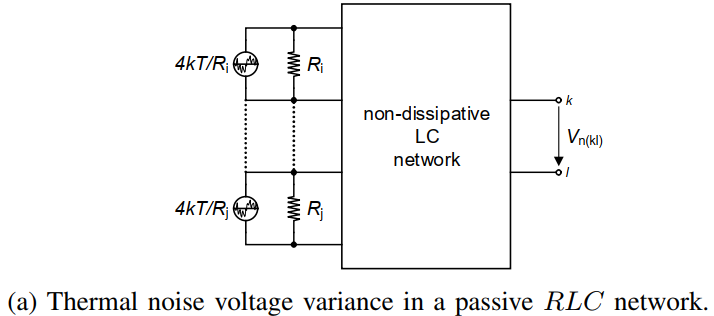
where all resistors are modeled by a noiseless resistor in parallel with a noisy current source with power spectral density
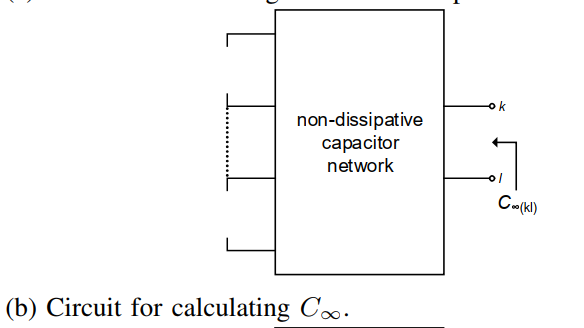
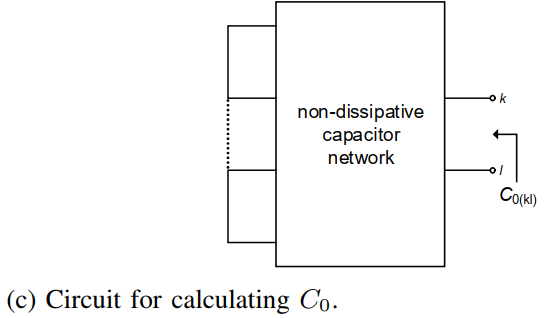
Capacitance
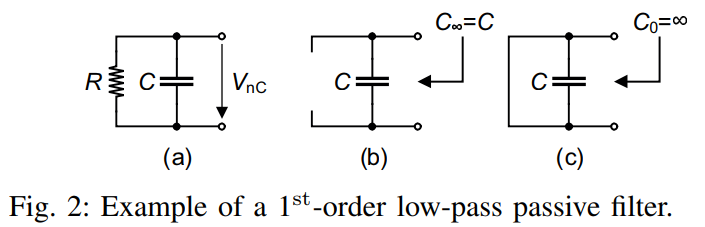
The simplest example of the application of the Bode theorem to a passive RC circuit is the
Ref: Equivalent Noise Sources of Switched-Capacitor Elements
Reference
[1] Enz, C., Caizzone, A., Boukhayma, A., & Krummenacher, F. (2019). Simple Thermal Noise Estimation of Switched Capacitor Circuits Based on OTAs–Part I: Amplifiers with Capacitive Feedback. arXiv preprint arXiv:1908.08099.
[2] Enz, C., Rengifo, S. C., Boukhayma, A., & Krummenacher, F. (2019). Simple Thermal Noise Estimation of Switched Capacitor Circuits Based on OTAs–Part II: SC Filters. arXiv preprint arXiv:1908.08109.